Artificial Intelligence and data-driven technologies” talent profile: A glimpse into the AI world of the STEAM Excellence Program
arany.barna.dora2026-03-10T14:22:54+02:00One of the most exciting chapters of the STEAM Excellence Program has concluded: the “Artificial Intelligence and Data-Driven Technologies” talent profile. Over the past few weeks, participating high school students did more than just learn about the technologies of the future; they were granted a look into the “engine room” where tomorrow’s world is being built.
The goal of this course series was to dismantle the walls between theoretical science and practical implementation. Let’s explore the milestones that led students from microcontrollers to complex neural networks!
Virtual replicas and the knowledge of the research group
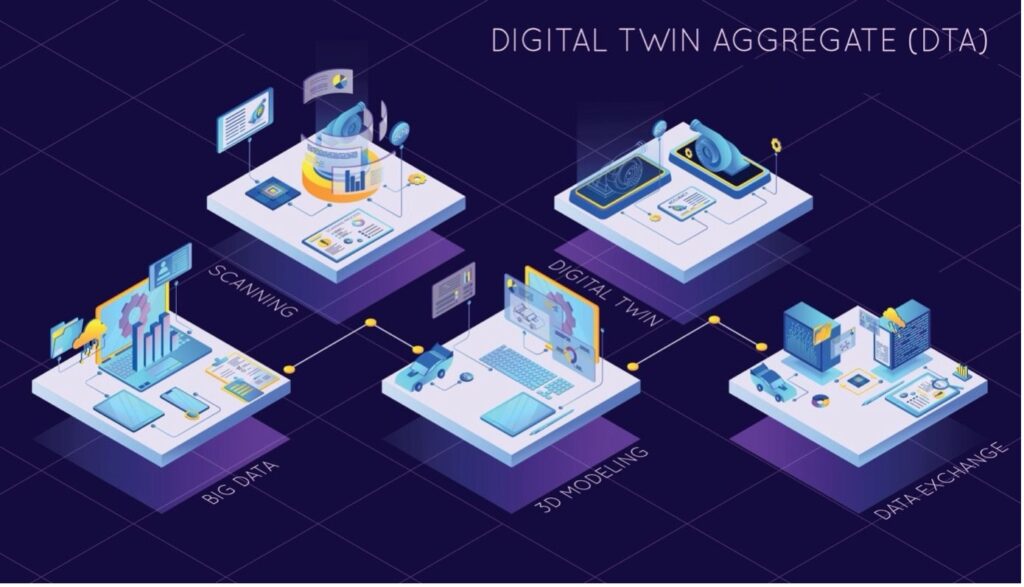
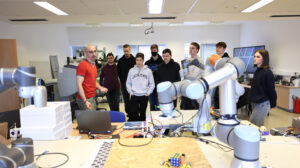
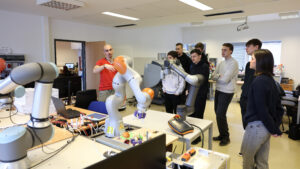
A defining stage of the program was the day dedicated to Digital Twin technologies and cyber-physical systems, where Prof. Dr. Péter Galambos, Vice-Rector for Innovation, and his expert team demonstrated the diversity of the field.
During the morning session, students saw that research is not a solitary pursuit:
András Makány, Researcher and Developer at the Antal Bejczy Center for Intelligent Robotics (iROB), introduced participants to the fundamentals of digital twin technology, showing how a machine can exist simultaneously in physical and virtual space.
Ármin Károly, Technician at iROB, initiated the youth into the mysteries of machine vision, an essential component for machines that sense their environment.
Sándor Tarsoly, Institutional Engineer at iROB, spoke about agricultural applications: students observed how sensors monitor mushroom growth and were introduced to a specialized robotic arm designed for mushroom picking.
Surgical robots and robot dogs: An interactive future
The highlight of the laboratory visit was the hands-on experience. Participants saw the world-famous DaVinci surgical robot up close—the pinnacle of precision engineering. Additionally, industrial robotic arms were showcased, demonstrating their ability to sort items one by one from bulk piles, which remains one of the greatest challenges in logistics.
Furthermore, students could interact with the lab’s robot dog and observe an inverted pendulum project—a hobby-sized yet technologically brilliant feat that demonstrates the fundamentals of control engineering in a playful manner.
Can a robot learn from YouTube?
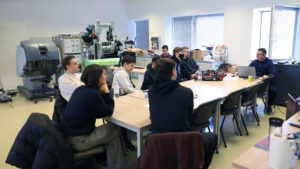
One of the most fascinating segments of the event was Prof. Dr. Péter Galambos’s lecture on modern AI developments. The Professor highlighted a key difference between text-based and motion-based Artificial Intelligence.
While models like ChatGPT have a relatively “easy” task—as written text found on the internet can be immediately ingested by statistical algorithms as uniform “code snippets”—teaching robots to move is an extremely slow and costly process.
However, the solution is closer than we think! The Professor demonstrated how video platforms like YouTube can be used to train robots. By back-calculating physical parameters from human movements seen in videos, machines can learn “by observation.” Just as we do: we watch a sporting event on TV and then try to mimic the movements.
The soul of machines and individual paths
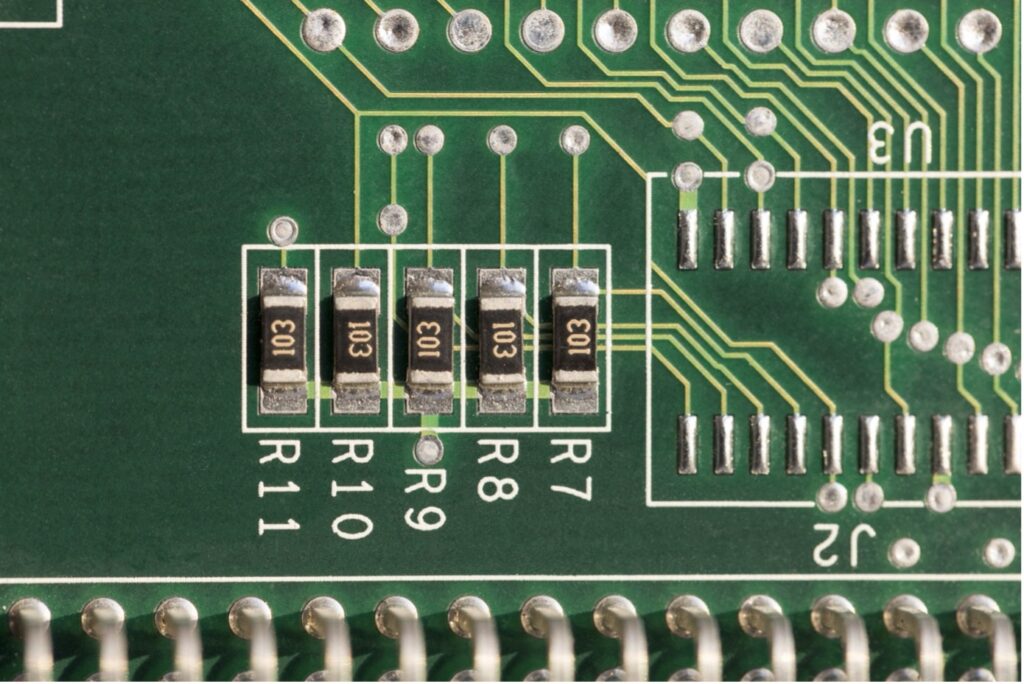
Technology consists of more than just software. Under the guidance of Tamás Sándor, Assistant Lecturer at the Kandó Kálmán Faculty of Electrical Engineering – Institute of Electronic and Communication Systems, students delved deep into microcontroller programming, where written code transformed into physical motion or perceptible data.
What truly makes the STEAM Excellence Program unique, however, is the individual attention. During modular evaluation and individual consultation, talents received personalized feedback, helping them immerse themselves in the worlds of AI research or software development according to their specific interests.
The code of the future: Ethics and evolution
As the closing chord of the talent profile, Dr. habil. Gábor Kertész, Vice-Dean for Research and Associate Professor (John von Neumann Faculty of Informatics – Institute of Software Design and Development), led participants toward the horizon of AI and future technologies. The discussion covered not only technical foundations—such as the inner workings of neural networks—but also questions that concern everyone:
“Where are the limits of Artificial Intelligence, and what ethical responsibility rests on the developers of the future?”
Students traced the evolution of AI from rule-based systems to today’s self-learning deep neural networks, gaining an understanding of scaling trends and the social impacts of the technology.
Why is this important?
The STEAM Excellence Program provides more than just a curriculum; it offers inspiration for careers in engineering, informatics, and AI research. Participants are no longer just users, but informed observers (and hopeful creators) of the technological revolution that is reshaping everything from healthcare to education.
Congratulations to all participants who successfully completed this talent profile!
Our STEAM Excellence Program is funded by the National Talent Programme under the grant NTP-STEM-25-B-0006.